

Select your language
When Your Body Shows No Symptoms, It Doesn't Always Mean Your Lungs Are Healthy
"Many people do not lose the battle against lung cancer—they lose the opportunity for early detection."
Lung cancer remains one of the world's leading causes of cancer-related deaths.
Despite significant advances in medical technology and treatment, many patients are still diagnosed only after the disease has progressed to Stage III or Stage IV.
A common question is often asked:
Why is lung cancer still discovered so late, even with today's medical advancements?
The answer lies in one of the disease's most challenging characteristics.
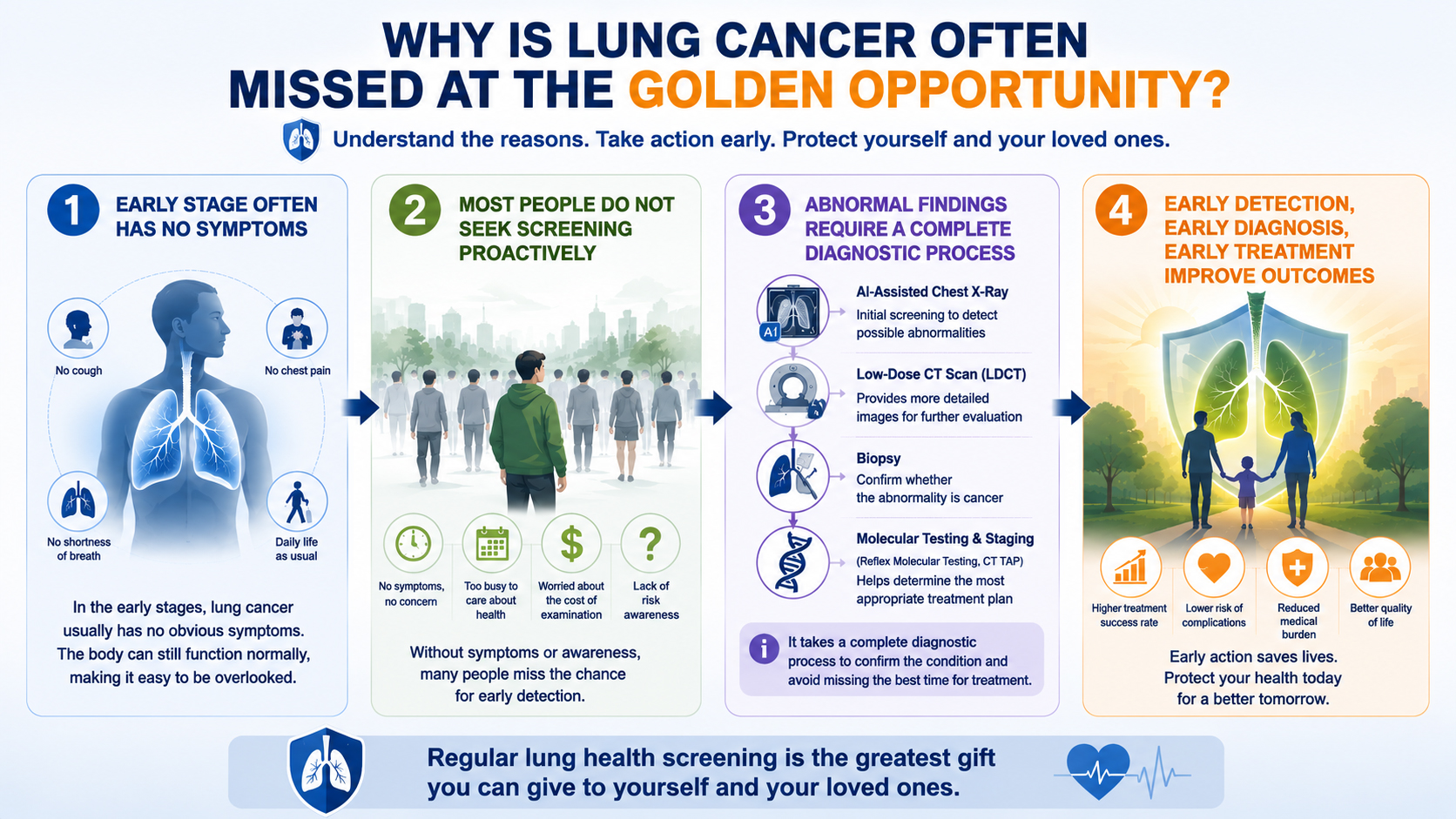
In its earliest stages, lung cancer often develops silently, without noticeable symptoms.
Feeling Well Does Not Always Mean Your Lungs Are Healthy
Many people believe that if they are not coughing, experiencing chest pain, or struggling to breathe, their lungs must be healthy.
Unfortunately, this is not always true.
The lungs have a remarkable ability to compensate even when part of the lung tissue has already developed abnormalities.
As a result, many individuals continue to work, exercise, care for their families, and enjoy everyday life without realising that changes may already be taking place inside their lungs.
By the time symptoms become obvious, the disease may already require far more complex treatment.
This is why healthcare professionals consistently remind us:
The absence of symptoms does not mean the absence of risk.
"I Don't Smoke, So I Won't Get Lung Cancer."
This remains one of the most common misconceptions about lung cancer. While smoking continues to be one of the most significant risk factors, it is not the only cause.
In recent years, a growing number of lung cancer patients have never smoked.
Other factors that may increase the risk include:
Long-term exposure to second-hand smoke
Air pollution, including fine particulate matter (PM2.5)
Occupational exposure to dust or hazardous chemicals
Prolonged exposure to cooking fumes
Family history
Increasing age
Lung cancer is therefore not a disease that affects only smokers.
It is a health issue that deserves greater awareness across the entire community.
Perhaps the more important question is not "Do I smoke?"
It is:
"Have I ever taken the initiative to check my lung health?"
Why Are So Many Cases Diagnosed at an Advanced Stage?
One principle applies to many forms of cancer:
The earlier cancer is detected, the better the opportunity for successful treatment.
Lung cancer is no exception.
The challenge, however, is that it rarely causes symptoms in its earliest stages.
Many patients first discover an abnormality not because they felt unwell, but because a routine medical examination or chest imaging revealed an unexpected finding.
That single image often becomes the turning point that changes the course of a person's life.
This is why preventive healthcare increasingly promotes one important message:
Health screening is not about assuming you are ill. It is about confirming that you are healthy.
AI Is Helping Detect Potential Risks Earlier
Artificial intelligence (AI) has become an increasingly valuable tool in modern medical imaging.
Through an AI-assisted Chest X-ray, healthcare professionals can identify chest images that may require further evaluation more efficiently, helping to improve the effectiveness and consistency of initial lung health screening.
It is important to emphasise that AI does not replace physicians. Instead, it functions as a clinical decision-support tool, assisting doctors while the final diagnosis remains the responsibility of qualified medical professionals.
For communities, this means more individuals may have the opportunity to investigate potential lung abnormalities before symptoms appear. And that is one of the greatest strengths of preventive healthcare.
Early Detection Is Only the Beginning
Many people assume that once a health screening is completed, the process is over.
In reality, the most important step often comes next.
If an AI-assisted Chest X-ray identifies a suspicious abnormality, eligible participants may proceed to a Low-Dose Computed Tomography (LDCT) scan for a more detailed assessment.
If necessary, physicians may recommend a lung biopsy, followed by Reflex Molecular Testing and CT Thorax, Abdomen and Pelvis (CT TAP) staging should lung cancer be confirmed. These investigations help clinicians establish an accurate diagnosis and determine the most appropriate treatment strategy.
This stepwise diagnostic pathway is designed to minimise missed diagnoses and ensure that individuals who require medical attention receive timely follow-up care.
Why Do Some People Never Complete the Diagnostic Journey?
One challenge frequently encountered in healthcare is that some individuals do not continue with further investigations after an abnormal screening result.
Concerns about cost, uncertainty, or complicated medical procedures may discourage them from taking the next step.
To address this barrier, NCSM LungShield incorporates LungLife, a complementary insurance component that supports eligible participants by covering subsequent diagnostic procedures when abnormalities detected through the AI-assisted Chest X-ray meet the programme's specified criteria.
Because effective healthcare is not only about identifying potential problems—
it is about ensuring people can continue the journey towards a confirmed diagnosis.
Don't Wait Until Your Body Sends a Warning
Modern life keeps us busy.
We dedicate our time to work, our families, and our responsibilities. Yet we often overlook the one thing that makes all of these possible—our own health.
The challenge with lung cancer is that it rarely announces its presence in the beginning.
It doesn't ask you to take a day off.
It doesn't insist that you visit a hospital tomorrow.
It simply progresses quietly.
Until one day, someone may hear the words:
"If only we had found it earlier."
Rather than waiting for symptoms to appear, taking a proactive step towards lung health today may make all the difference tomorrow.
WPWAF: Helping Communities Take the First Step Earlier
At WPWAF, we believe that public welfare should not begin only after illness occurs.
It should begin with education, awareness, and prevention.
On 17 October 2026, WPWAF and the National Cancer Society of Malaysia (NCSM) will organise WIRA Cancer Activation 2026, encouraging the public to embrace the principles of early detection, early diagnosis, and timely treatment through community health education and AI-assisted lung health screening.
Because the action that changes a life is often not the treatment itself—
it is taking the first step early.
Event Information
WIRA Cancer Activation 2026
1,000 AI-Assisted Lung Health Screening & Guinness World Records™ Attempt
Date: 17 October 2026 (Saturday)
Time: 8:00 AM – 10:00 PM
Venue: Sunway Square Mall, Bandar Sunway, Selangor, Malaysia.
Join WPWAF and the National Cancer Society of Malaysia in promoting preventive healthcare and encouraging every individual to take an important step towards protecting their lung health.
About WPWAF
The World Public Welfare Alliance Foundation (WPWAF) is an international non-profit organisation dedicated to advancing global public welfare through initiatives in healthcare, education, culture, environmental sustainability, and technology.
Guided by its vision, "Where Worldkind Begins," WPWAF brings together individuals, organisations, and communities worldwide to build a healthier, more compassionate, and sustainable future.